Colours, Sights & Patterns At Kampong Glam

In the 19th century, Kampong Glam was essentially an ethnic district with a strong Malay-Arab influence. It was a place where locals patronized for their Arab-Muslim traditional foodstuff and merchandise...

Immersive 4K HDR Viewing Experience With Sony Projectors

Sony’s latest innovative laser light source projector is High Dynamic Range (HDR) compatible with native 4K resolution, creating an amazling clear lifelike experience, as if you are there yourself…

Back 30 Years To Upper Serangoon Shopping Centre

Iconic along this stretch of road is the rectangular block of a nondescript beige-tiled building. The facade of this building is blocked by an overhead bridge. And this is the front entrance to a shopping centre - the Upper Serangoon Shopping Centre… (USSC).

Monti - Singapore's Longest Brunch Every Sunday

Enjoy brunch by the bay concept, complete with stunning views of the Marina Bay and its surroundings, and a fabulous menu and music programme to match at Monti…

Where Freemasons Convene

In 1886, the Masonic Club was established to support Singapore freemasonry. Guess who was the first Freemason in modern Singapore?

Fullerton Heritage - Heritage Gallery

Raffles Place
South, Singapore
March 2013
(This article is part of Merlion Wayfarer's Fullerton Heritage Guided Tour series.)
The Fullerton Heritage Gallery showcases the rich heritage and history of the precinct. The 800-square foot gallery features displays that include photographs, maps, stamps and philatelic materials that date back to 1932. Some of the highlights include two red pillar post boxes, which found its way to the streets of Singapore in 1873 during the British Colonial rule, and the return of the Foundation Stone laid by the first President of Singapore, Mr Yusof bin Ishak.
 An easel sign indicating the Heritage Tours offered by the Hotel...
EIIR Pillar Boxes and Postman Bears are on sale in the hotel lobby...

 A unique unicorn-elephant, the Unicelephant by Philip Treacy,
was purchased by the Hotel as part of the Elephant Parade fund towards elephant conservation...
  

  Florence explains the history of the waterfront near the Hotel...
Exhibits relating to GPO's history are displayed in the shelves...

 An adjacent art gallery displays works for sale...

Showcasing how postboxes have changed over the years...

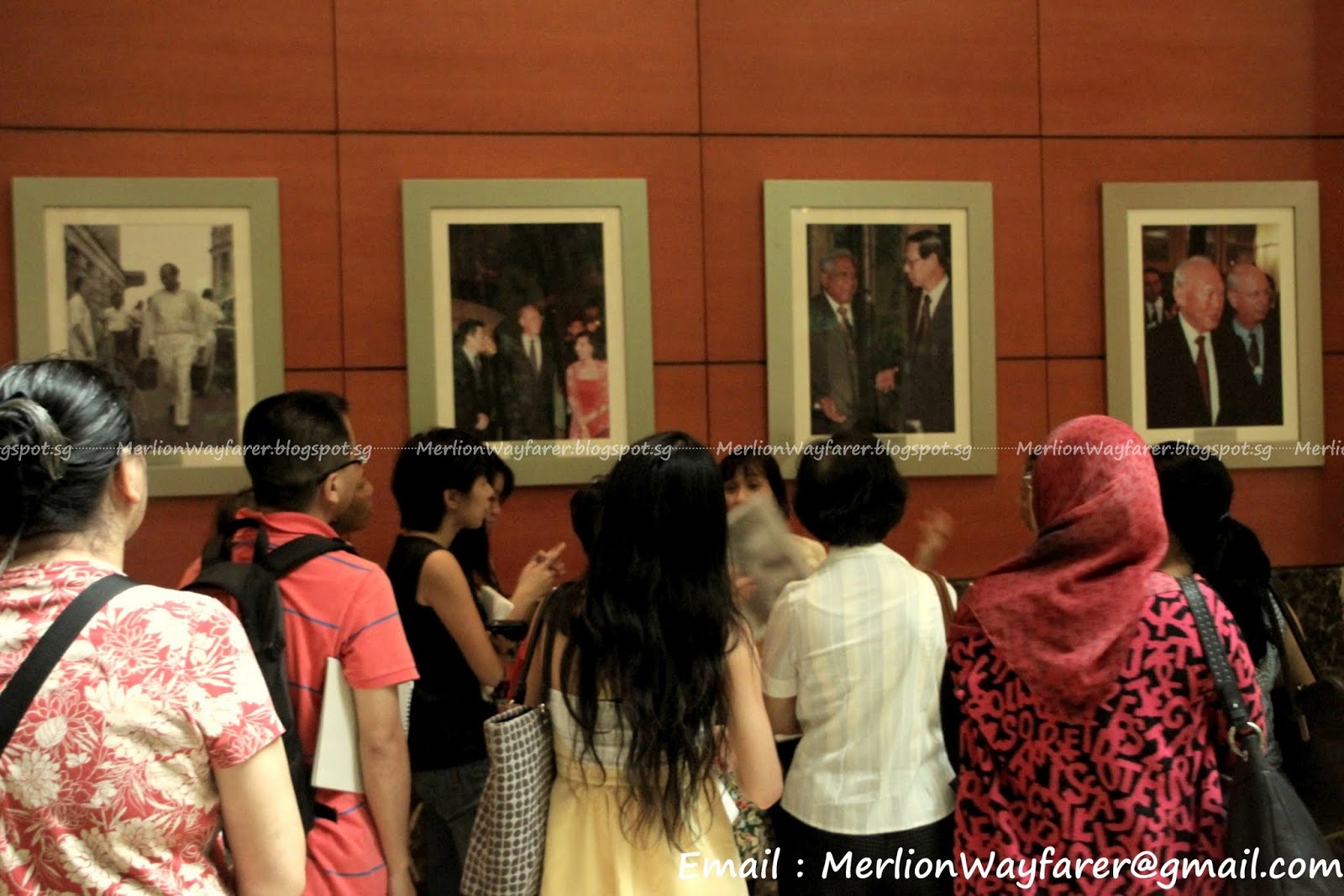
 A wall lined with photographs of dignitaries and celebrities who have visited the Hotel...


The full album is available at:
Merlion Wayfarer's Picasa (Places - Fullerton)


Sources

Fullerton Heritage - Extravagant Architecture

Raffles Place
South, Singapore
March 2013

(This article is part of Merlion Wayfarer's Fullerton Heritage Guided Tour series.)
 
In 1919, Singapore celebrated its first Centenary. The year was regaled with much public festivities and projects, the most ambitious being the Fullerton Building - the largest structure ever built in Singapore. It was to be a "monument worthy of the city" and was to symbolize the new wealth and power of Singapore.

A London architect, Major PH Keys, was commissioned to design the building. Arriving in Singapore in 1920, Major Keys brought with him the designs and concepts of Greek Classical architecture, echoing the Parthenon in Athens, considered to be de rigeur for official public monuments. Only classical architecture, with its use of columns, porticos and decorations, could convey the power and splendour of the British Empire, and provided yet another example of the neo-classical Art Deco architecture that once dominated the financial district. Typical of this style is a graceful interior adorned with heavy moulding and ornamentation. The architecture was adapted with high ceilings and deep verandas to cater for Singapore's tropical weather.

After years of controversy over the costs and extravagance of the project, the foundations were laid in 1924. Named after Robert Fullerton (Governor of Singapore, 1826-1829), it was built primarily to house the General Post Office. Other bodies which once occupied the premises include the exclusive Singapore Club and the Inland Revenue Department. The building was completed in 1928 at the grand cost of $4,098,808.
The exterior of grey Aberdeen granite was composed with  artificial stone made from crushed granite chips melted into cement to create a lasting weather-proof finish. There are now 32 Doric columns with some removed during the Fullerton Hotel's refurbishment to accommodate the outdoor swimming pool.
Sitting on 41,100 square metres (442,400 square feet) of land with walls measuring 36.6 metres (120 ft) from the ground, the building has neo-classical architectural features which include fluted Doric colonnades on their heavy base, and the lofty portico over the main entrance with trophy designs and the Royal Coat of Arms, crafted by Italian Cavaliere Rudolfo Nollix.
Originally, there were five distinct frontages, each treated in the Doric order. 14 elevators served the four floors plus the basement floors. A hollow cellular raft foundation was proposed by the original contractors in 1920s to save cost because bedrock lies directly below the building.

Majestic three-storey high columns partition the areas of the hotel lobby...


The full album is available at:
Merlion Wayfarer's Picasa (Places - Fullerton)


Sources

Fullerton Heritage - Restoration Works

Raffles Place
South, Singapore
March 2013
(This article is part of Merlion Wayfarer's Fullerton Heritage Guided Tour series.)


In 1997, the 72 year old building, along with a piece of the waterfront was acquired, by Sino Land, the Hong Kong arm of the Far East Organisation, at a cost of S$110 million for development into a hotel. Architects 61, together with DP Consultants, was engaged to convert it into a 400-room luxury hotel with the hotel rooms designed by Hirsch Bedner Associates. Renovation works costing a total of S$400 million were carried out over three years on the building, with only minor alterations to the exterior as stipulated by URA conservation guidelines.
Interesting features found during work on the Fullerton Building include an old postal tunnel that led all the way out to the sea for postal boats to deliver and collect mail and the partially water-submerged raft foundation under the building that rendered it effectively floating.
The acquired waterfront parcel was developed into a two-storey commercial complex - One Fullerton - which is linked via a underground passageway to Fullerton Hotel. Works were completed on 08 December 2000 and the Fullerton Hotel was officially opened by PM Goh Chok Tong on 01 January 2001, after the Fullerton's New Year Eve party countdown.

Soothing earth tones and beech are used for the interior design.
On guest floors, passageways link the rooms from the bay view rooms to the courtyard and river view rooms...
View of the hotel from the passageways...
An antique dial phone is displayed at the lift lobby...


Majestic lionheads guard the entrance of the hotel at Fullerton Square...
A bust of Ng Teng Fong was recently installed in the lobby of Fullerton Hotel. Singapore billionaire property tycoon Ng Teng Fong was the chairman of the Far East Organization. Fullerton Hotel is among
the over 700 malls, condominiums and hotels in Singapore and Hong Kong owned by the group...

A skylight spanning 2/3 of the hotel lobby allows in natural light,
thereby improving energy conservation during daytime...

Which is much needed, given the energy consumption of the warm lighting
provided by the elegant but energy-intensive lamps...

 Functional features are well-hidden into the hotel design...
A thoughtful gesture to provide lounge guests with racks at coffee tables
for their neckties, coats and briefcases...
  
A koi pond with well-fed koi fish in the basement to retain the water wealth...
Welcoming cushions provided on well-maintained leather and velvet seats
encourage one to take a breather from the humid tropical weather outside...
 
  • "A peek into the Fullerton" by Koh, Boon Pin (06 June 2000). The Straits Times.
  • "Fullerton Hotel" by Phyllis Wee (28 May 2001) . Singapore Infopedia, National Library Board.
  • "Fullerton wins heritage award" by Sim, Arthur (19 July 2001). The Straits Times.
  • "Singapore property tycoon Ng Teng Fong dies" by Hoe, Yeen Nie (02 February 2010). Singapore News, Channel News Asia. Retrieved from http://www.channelnewsasia.com/stories/singaporelocalnews/view/1034717/1/.html (19 March 2013).


Fullerton Heritage - Fullerton Square

Raffles Place
South, Singapore
March 2013 
(This article is part of Merlion Wayfarer's Fullerton Heritage Guided Tour series.)
 
Located in the Downtown Core of the Central Region beside the Singapore River, Fullerton Square was likewise named in honour of Robert Fullerton, the first Governor of the United Settlements (1826 -1830).
 
Fort Fullerton used to stand on the site which is today known as Fullerton Square. The Fort with Artillery Barracks, a house for officers and barracks for soldiers was built in 1829 to defend the town of Singapore at the river mouth. On Battery Point, 68-pounder guns guarded the entrance to the River against Dutch invasions.
 
The battery (at where today's Battery Road now resides) was never used against the Dutch. The only time that it was used was against traders and merchants who rioted against the test firing of the cannons.  Each time that the cannons fired, due to the loud noise, goods being loaded or unloaded would fall into the river. These goods were then sold at half price.
  
In 1882, a Victorian-styled fountain was installed in Fullerton Square in commemoration of influential merchant Tan Kim Seng's donation to the City's Waterworks. When the Tan Kim Seng Fountain was moved to the Esplanade in 1925, the space became a car park which became the venue for many, heavily attended, election rallies in the past.
  
Fullerton Square was a popular election rally site for the ruling party, the People's Action Party (PAP) from 1959 - 1988. Thereafter, the election rally site moved to the current Raffles Place where the UOB Plazas are located and near the Fernando Botero bird sculpture alongside the river.

Majestic lionheads guard the entrance of the Fullerton Hotel at Fullerton Square...


Sources


Fullerton Heritage - The Straits Room

Raffles Place
South, Singapore
March 2013
(This article is part of Merlion Wayfarer's Fullerton Heritage Guided Tour series.)
 
The Singapore Club, or Town Club, as it was later known, was the exclusive European bastion of colonial Singapore. It was the most prestigious club in the East, with a 300-foot long bar and a stately Billiard Room now known as The Straits Room.
Located on Level 4 of The Fullerton Hotel, The Straits Room is an exclusive enclave distinctly well-appointed for formal banquets, private receptions, seminars and press conferences. Its lofty height and unique coffered ceiling - Singapore’s only barrel-vaulted example - and crystal chandeliers added to its elegant atmosphere. Both the ceiling and wall motifs are original design elements from 1928 that were retained when the magnificent Fullerton Building was restored.

The view of the room from opposite ends - The epitome of elegance and beauty...

The beautifully-crafted cornice on the arch ceiling, the engraved wooden mirrors,
and the golden easel stands...

The grand hanging chandeliers with their shimmering crystals...

The newer ceiling in the bar counter outside the room with adjustable coloured mood lighting...

A polished wood acoustic Yamaha upright piano,
a brand known for over 100 years of skilled craftmanship...

Wine glasses line the bar counter in preparation for the evening's event...

Sources


Fullerton Heritage - The Salon

Raffles Place
South, Singapore
March 2013

(This article is part of Merlion Wayfarer's Fullerton Heritage Guided Tour series.)
     
The only boutique with an exclusive entrance accessed from outside the hotel, Salon de Florere is a chic cosy salon offering exclusive hair and styling services headed by the experienced Fumio Nakahata from Japan.
Built with a private lift and an exterior entrance, it was originally a saloon for high-ranking British aristocrats where the gentlemen from England, Scotland and Wales gather.


The full album is available at:
Merlion Wayfarer's Picasa (Places - Fullerton)


Sources


Fullerton Heritage - General Post Office

Raffles Place
South, Singapore
March 2013

(This article is part of Merlion Wayfarer's Fullerton Heritage Guided Tour series.)
  
The Fullerton Hotel is remembered as the site of the original General Post Office (GPO). It was the anchor tenant, which only moved in a fortnight after the Fullerton Building's official opening. The GPO covered the two lower floors with postal halls, offices and sorting rooms.
The postal counter stretched from the current location of the bar counter in the Post Bar to the Jade Restaurant at the other end of the hotel. At 300 feet long, it was the longest in South-East Asia.
There were mail drops through which mail would fall to a band conveyor on the basement and dispatched up to the sorting room. The basement was connected to a 35-metre subway that ran underneath Fullerton Road to a pier, where overseas mail would be transferred to or picked up from ships.
During World War 2, the Fullerton Building was converted into a military hospital.

The Post Bar


Named after the main tenant of the Fullerton Building before its restoration, the ground floor Post Bar is a pub with fine dining facilities and al fresco dining options in the adjoining outdoor East Garden. A popular drink is its very own Fullerton Sling.
One of the few places left in the entire hotel where the original ceiling is retained...
The length of the original ceiling runs along the width of the Post Bar...

Red Pillar Boxes

The first Pillar Post Box was installed in 1873 during the British colonial era. As part of the effort to preserve the memories and as a tribute the GPO, two original Red Pillar Post Boxes have been retained - at the Post Bar and at the Fullerton Heritage Gallery. These boxes were specially shipped in from Great Britain and feature the EIIR (Elizabeth II Regina) British royal cipher on its door as a symbol of the ruling monarchy at the time when the pillar post box was produced - during the reign of Queen Elizabeth II.

An operational postbox in the Post Bar - Mail is collected at 5pm every weekday...

At the bottom of the postbox, a dial with the locations of countries around the globe is shown
with the distance indicated in road journeys...
Today, the only other similar operational postbox stands at the entrance of the Singapore Philatelic Museum at Coleman Road near Dhoby Ghaut.


The full album is available at:
Merlion Wayfarer's Picasa (Places - Fullerton)


Sources

  • "Singapore's 100 Historic Places" by National Heritage Board (2002). Archipelago Press.
  • "Fullerton Building" by Cornelius-Takahama, Vernon  (19 May 2001) .  Singapore Infopedia, National Library Board.

Fullerton Heritage - Founding Of Modern Singapore

Raffles Place
South, Singapore
March 2013

(This article is part of Merlion Wayfarer's Fullerton Heritage Guided Tour series.)
  
      
The founding of modern Singapore in 1819 by Sir Stamford Raffles paved the way for Singapore to become a modern port and established its status as a gateway between the Western and Eastern markets. This was distinct from its earlier probable use as a port in ancient times during the dominance of Srivijaya, and later, Melaka in the region. This was because previously, the main markets were India and China. However, with the founding of modern Singapore, Europe, and to an extent the United States, had now become sources of trade as well.
Raffles actually came to Singapore more than once during his career with the East India Company:
  • 28 January 1819 : Raffles landed on St John's Island. This was followed by an approach to a Malay settlement at the mouth of the Singapore River the next day, and the subsequent signing of a treaty with  Sultan Hussein and Temenggong Abdul Rahman to set up a British outpost on 06 February 1819. After issuing orders to Major William Farquhar and the remaining Europeans, Raffles left the next day, 07 February 1819.
  • 1822 : Dissatisfied with some of the policies implemented by Farquhar, Raffles returned to Singapore to appoint John Crawfurd as the new Governor. After drafting the first constitution for Singapore, he boarded a ship for England on 09 July 1823.

Merlion Wayfarer's Fullerton Heritage Guided Tour Series


Sources