Colours, Sights & Patterns At Kampong Glam

In the 19th century, Kampong Glam was essentially an ethnic district with a strong Malay-Arab influence. It was a place where locals patronized for their Arab-Muslim traditional foodstuff and merchandise...

Immersive 4K HDR Viewing Experience With Sony Projectors

Sony’s latest innovative laser light source projector is High Dynamic Range (HDR) compatible with native 4K resolution, creating an amazling clear lifelike experience, as if you are there yourself…

Back 30 Years To Upper Serangoon Shopping Centre

Iconic along this stretch of road is the rectangular block of a nondescript beige-tiled building. The facade of this building is blocked by an overhead bridge. And this is the front entrance to a shopping centre - the Upper Serangoon Shopping Centre… (USSC).

Monti - Singapore's Longest Brunch Every Sunday

Enjoy brunch by the bay concept, complete with stunning views of the Marina Bay and its surroundings, and a fabulous menu and music programme to match at Monti…

Where Freemasons Convene

In 1886, the Masonic Club was established to support Singapore freemasonry. Guess who was the first Freemason in modern Singapore?

Thaipusam 2012 - Every Painful Step Of The Way

Serangoon Road to Tank Road
Little India
Central, Singapore
February 2012

 
A festival occurring in the Tamil month Thai (January-February), the day of the star Pusam around Pournami (Full Moon) is celebrated as Thaipusam. It is a special day for worship of Lord Muruga (also known as Subrahmanya or Thendayuthapani) and is celebrated in a very grand manner at all Murugan temples. This festival honours Muruga or Subramanya, the son of Shiva.

Kavadi Attam is a dance performed by the devotees during the ceremonial worship of Murugan, the Tamil God of War. It is often performed during the festival of Thaipusam and emphasizes debt bondage. The Kavadi itself is a physical burden through which the devotees implore for help from the God Murugan. Generally, Hindus take a vow to offer a kavadi to idol for the purpose of tiding over or averting a great calamity. 

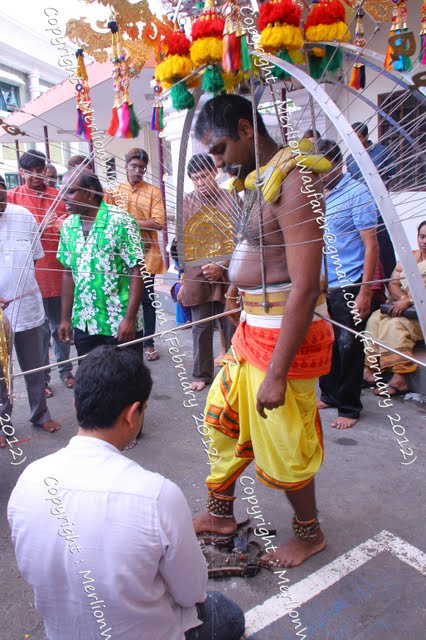
In Singapore, the Thaipusam ceremony starts in the early hours of the morning where devotees fulfill their vows with a 4.5 km walk from Sri Srinivasa Perumal Temple along Serangoon Road to Sri Thendayuthapani Temple on Tank Road. The first batches of devotees usually carry milk pots and wooden kavadis. A kavadi consists of two semicircular pieces of wood or steel which are attached to a cross structure that can be balanced on the shoulders of a devotee. It is often decorated with flowers, palm leaves and peacock feathers. The milk they have been carrying is then offered to Lord Subrahmanya at the Sri Thendayuthapani Temple. Some devotees also pierce their tongues with skewers and carry a garlanded wooden arch across their shoulders. Devotees carrying spiked kavadis, which require elaborate preparations, leave the temple in the later part of the morning and continue till night. The festival is not just an exclusively Indian affair; several Chinese devotees and people of other races also come to fulfill their vows on this day. 

It takes a whole team of people to adorn and assemble the kavadis...


The kavadi-bearers not only had to carry the 30-kg kavadis, 
they also endured body piercings...


Witnessing the mouth-piercing process was a very intense experience - 
It took an incredible amount of effort to insert the spikes, 
and an even greater amount of endurance to be the one being spiked. 
We were moved by the amount of trials that the kavadi-bearers underwent...


The kavadi-bearers with the piercings - 
Night kavadis were decorated with lights to illuminate their bearers' paths...
 
There were others wore sandals lined with hundreds of nails 
as a testament of their gratitude...
These two families rallied around their teenage boys with songs and their presence 
to encourage them on their journeys...
 
For some others, it was a time to sing and dance to celebrate the journey...
 
It was not an easy task to remove the spikes. 
It is not true that the devotees do not feel the pain. 
Neither is it true that they do not bleed...
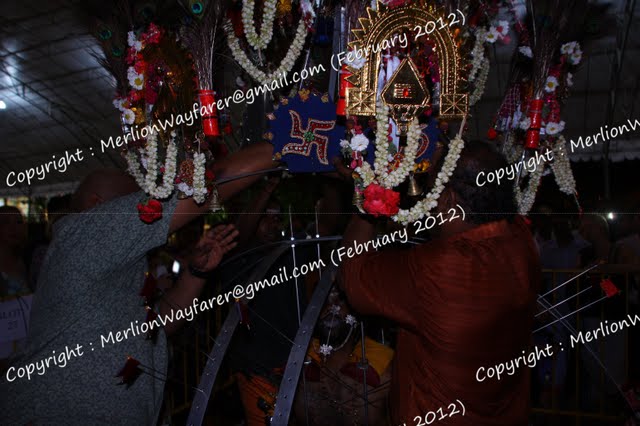
 
Thaipusam is a moving event of pure devotion and endurance 
which truly reflects the bonds between the devotees and their family and friends 
who were there for them - every painful step of the way... 


More photos are available on Merlion Wayfarer's Picasa at :
Festivals - Thaipusam

Sources


Chinese New Year 2012 - Enter The Water Dragon!

Singapore
January-February 2012
 
Chinese New Year is the most important of the traditional Chinese holidays. In China, it is known as "Spring Festival," the literal translation of the Chinese name 春节 (Pinyin: Chūnjié), since the spring season in Chinese calendar starts with lichun, the first solar term in a Chinese calendar year. It marks the end of the winter season, analogous to the Western Carnival. The festival begins on the first day of the first month (Chinese: 正月; pinyin: Zhēngyuè) in the traditional Chinese calendar and ends with Lantern Festival which is on the 15th day. Chinese New Year's Eve, a day where Chinese families gather for their annual reunion dinner, is known as Chúxī (除夕) or "Eve of the Passing Year." Because the Chinese calendar is luni-solar, the Chinese New Year is often referred to as the "Lunar New Year".


Chinese New Year is the longest and most important festivity in the Chinese calendar. The origin of Chinese New Year is itself centuries old and gains significance because of several myths and traditions. Chinese New Year is celebrated in countries and territories with significant Chinese populations, such as Mainland China, Hong Kong, Macau, Taiwan, Singapore, Thailand, Indonesia, Malaysia, Mauritius, Philippines, Vietnam, and also in Chinatowns elsewhere. Chinese New Year is considered a major holiday for the Chinese and has had influence on the lunar new year celebrations of its geographic neighbours.

With its predominantly 75% Chinese population, Chinese New Year is celebrated with great gusto. There are several events which are arranged at different places in Singapore as part of Chinese New Year 2012 Singapore celebration.
  

Dances With Dragons

City Square Mall
Little India
Central, Singapore
January 2012

 
The Dragon Dance is a Chinese dance usually performed during the Chinese New Year and other auspicious occasions to bring in good luck and prosperity. In the dance, a team of people carry the dragon — which is an image of the Chinese dragon — on poles. The movements in a performance traditionally symbolise historical roles of dragons demonstrating power and dignity.

Dragons are believed to bring good luck to people, which is reflected in their qualities that include great power, dignity, fertility, wisdom and auspiciousness.

This year, 2012, is the year of the Dragon. It is one of the 12-year cycle of animals which appear in the Chinese zodiac, and the only animal that is legendary. The Year of the Dragon considered the luckiest year in the Chinese zodiac.

Here are my photo journals of the other fascinating CNY 2012 celebrations in Singapore:


Sources

Sentosa Flowers 2012 - Dragons Of A Thousand Petals

Sentosa Flowers Festival
South, Singapore
January 2012
 
The Sentosa Flowers Festival is the most celebrated flower festival in Singapore during the Chinese New Year. This event showcases the spectacular creations with thousands of tropical and spring flowers in an array of species in the outdoors. An annual flower festival started in 2005, it puts together some of the rarest and most unique flowers of spring, coming in all colours of the rainbow.

Starting the line-up is the boardwalk bridging Sentosa to the mainland. Lined with floral displays along its full 1km length, it leads to the Spring Wonderland filled up lollipop trees, giant flowers, and floral dinosaurs.

Rainbow-coloured blooms of hundreds of different flowers abound...


All forms of "dragons" peppered the displays
- some adorable, some artistic, some chubby, some fierce...

 
Birds paid a visit too...

 
Even the God of Fortune came by to distribute his wealth around...
 
Romantic heart-shaped structures adorn paths lined with roses and other blooms...

It's no wonder that couples, photographers, and families alike are all in the mood...


More photos are available on Merlion Wayfarer's Picasa at :
Events - Sentosa Flowers


Sources

  • "Sentosa Flowers 2012 - Flower Festival" (22 January 2012). YourSingapore.com. Retrieved from http://www.yoursingapore.com/content/traveller/en/browse/apps/eventdetails.sentosa-flowers-2012-flower-festival.html (Expired as of 2014).
      
  • "Sentosa Flowers 2012" by Megan COLLINS (21 December 2011). SingaporeHotels.com. Retrieved from http://www.singaporehotels.com/index.php/blog/post/457/sentosa-flowers-2012.htm (Expired as of 2014).

Clementi - A Step Back In Time

Clementi
West, Singapore
February 2011


Clementi is a town in Singapore, located in the west between Jurong and Dover, and commonly refers to the Housing and Development Board's housing estate of Clementi New Town. The town was named after the Governor and Commander-in-Chief of the Straits Settlements Sir Cecil Clementi. The Clementi Planning Area encompasses this entire area. Clementi is also the capital of the West Coast Group Representative Constituencies, whose head office is at Clementi Avenue 3.

Clementi and the roads therein are named after Sir Cecil Clementi Smith, Governor of the Straits Settlements from 1887 to 1893. The governor was an accomplished Chinese scholar. Among his achievements during his stint in office were laws brought into force to control secret societies in Singapore.
 
The signboard for Clementi with a faded picture of the town in its heyday,
yellowed by age and peeling at its corners...

  
Many of the residents are mature citizens, adding to the antiquity of the place...

 
Even the playground seemed left in a time warp...  

 
Fortunately, this spring, a breath of fresh air is breathed into the estate 
with the new flats and the upcoming Clementi Mall... 


More photos are available on Merlion Wayfarer's Picasa at :
Places - Clementi


Tua Pek Gong Birthday Celebrations 2010

Pulau Ubin
East, Singapore
May 2010
 
Pulau Ubin’s Tua Pek Kong festival was held on 27 May - 02 June 2010. There were live opera shows on the first 5 days followed by 2 days of Getai shows in the evening. Bumboat rides were free from 7pm to midnight.
 
Merlion Wayfarer was there as part of the group of 108 "heroes" (108 条好汉) to do the clean-up at Chek Jawa last weekend. They were fortunate to be greeted by the scores of colourful flags at the jetty on arrival, which made the ardous task ahead easier.


Ubin Oil Spill
|   Part 6 - Along The Way   |
 

Tua Pek Kong (大伯公)

Tua Pek Kong (Chinese: 大伯公, Da Bo Gong) is one of the pantheon of Malayan Chinese Gods. It was believed the date Tua Pek Kong arrived in Penang was 40 years before Francis Light in 1746.
 
Tua Pek Kong was a man named Zhang Li (张理) from the Hakka clan. His Sumatra-bound boat was struck by wind and accidentally landed on Penang island of Malaysia, which at that time had only 50 inhabitants. After his death, the local people began worshipping him and built the Tua Pek Kong temple there. Today Tua Pek Kong is worshipped by Malayan Chinese throughout the country, including Singapore.
Doesn't this look like Cambodia or Vietnam?
 

More photos are available on Merlion Wayfarer's Picasa at :
Festivals - Tua Pek Kong Birthday Celebrations